Wednesday, July 25, 2012

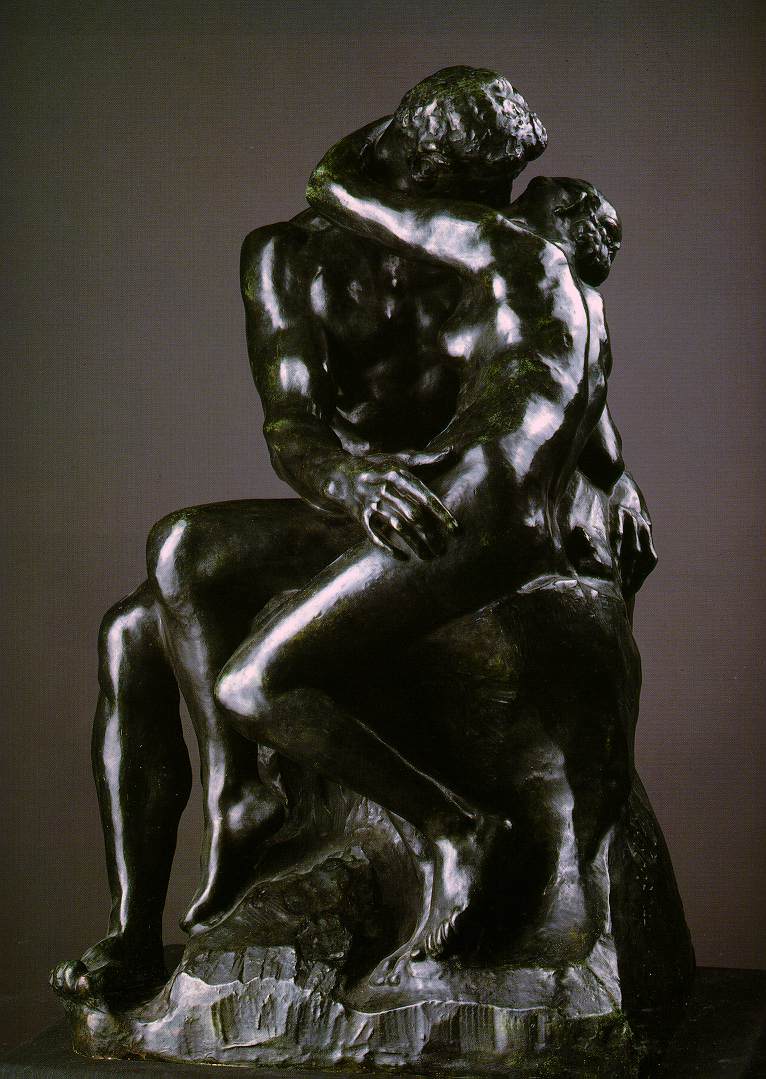
Rodin's "The Kiss"


When I first saw Rodin’s The Kiss, I was probably no older than ten years old and it has since been one of my favorite pieces. My mother is an avid lover of art and introduced me to many masterpieces at an early age. At that young age, I was in no way sheltered from nudity in art, and as such, when my classmates in junior high giggled in art class at nudes, I was completely comfortable.

The human body is one of God’s most beautiful creations. The intricasy in which it works and houses our souls is perfect in its design. It is no wonder then that the artists of the ages have sought to recreate the beauty of the human form. For me The Kiss is a tribute to God’s creation.

It can be argued that such a piece is not appropriate for display at a Church institution because perhaps it is pornographic in nature. I would disagree as the intent of the piece is not to arouse. The figures are placed in such a way that is tasteful and is meant to show the lines and forms of the human body. Rodin leaves areas of the sculpture undefined and places the hands in ways that are appropriate and natural. 
However the thing that bothers me the most about this story is how students were still allowed to study the piece in classes. Art history is much better learned by seeing the pieces than by looking at small pictures in textbooks. The idea that it is appropriate to study the piece in class but it is not appropriate to study the piece in a museum seems to me nonsensical and hypocritical. 

I’m sure President Bateman had his reasons to withhold the piece. However, if I ever get the chance to see The Kiss in person, I’ll be there and so will my children. 

Tuesday, July 17, 2012

Social Issues, pt. 2

1. The drug war:


"Our drunken bully who has by chance not slain his man passes a night of torture like that of Achilles when he bemoaned his friend, lying now upon his face, and now upon his back; he will get no rest in any other way, since some men can only sleep after a brawl."

A lot of gang activity and violence in our day is caused because of either drug trade or use. Juvenal describes the threat being beaten up by a "drunken bully" while walking home at night. 

2. Pornography:

The problem of immorality is also a problem for the Romans:

"Besides all this, there is nothing sacred to his lusts: not the matron of the family, nor the maiden daughter, not the as yet unbearded son-in-law to be, not even the as yet unpolluted son; if none of these be there, he will debauch his friend's grandmother"

Another tie to this is a lot of the art at Pompeii was pornographic in nature. 

3. Entitlement society:

Because of our society's sense of  entitlement we often live beyond our means and there is a lot of credit card debt problems. The Romans also did this according to Juvenal:

 "In Rome, every one dresses smartly, above his means, and sometimes something more than what is enough is taken out of another man's pocket. This failing is universal here: we all live in a state of pretentious poverty."

Another example is the way Nero basically burned down a huge part of Rome so that he could have a "decent" palace. 

4. Government/Corporate Corruption:

As Juvenal puts it, all governors are robbers:
 "No man will get my help in robbery, and therefore no governor will take me on his staff"

We similarly deal with the misuse of public funds and embezzlement. 

5. Healthcare crisis

One problem we have today is that the poor cannot afford healthcare because the cost is too high. A similar problem Juvenal shows happened with the Romans. Because of poor living conditions many Romans had poor health:

"Most sick people here in Rome perish for want of sleep, the illness itself having been produced by food lying undigested on a fevered stomach. For what sleep is possible in a lodging? Who but the wealthy get sleep in Rome?" 


Friday, July 13, 2012

Social Issues, pt. 1


Here’s what I think are some of the top five social issues today:

The War on Drugs: This has lead to numberless deaths in drug wars on the border and has put access to dangerous drugs in the hands of almost every American.

That's a lot of drugs. 


Pornography - It destroys families and effects an individual’s ability to have normal relationships. It can be accessed so easily that it’s difficult to prevent from being accessed accidentally.

Not saying that's what this guy is doing... it's just hard to find an appropriate pic for this one. 

Entitlement Society: Our society is getting more and more dependent on government handouts. People are feeling more entitled to things that they didn’t work for. This is leading to bankrupt US cities (i.e. Stockton, CA) and bankrupt countries (i.e. Greece, Spain)


Government and Corporate Corruption: It seems like every week or so there is a new news story about how some government  or corporate official has done something unethical, embezzled funds or lived “above the law.” 
I don't necessarily agree with the Occupy movement, but I thought this sign was pretty good. 
Healthcare: With the Affordable Care Act recently surviving the Supreme Court, there's been a lot of talk about this. Whether or not the bill will work or not, you can't deny that the health care system is broken. 


Thursday, July 5, 2012

When in America, do as the Romans do...


1. Ancient Rome was known for absorbing other cultures and integrating their art, customs and religions into their own. This I think is very similar to the present day United States in that we don’t have a dominant culture or ethnicity but are a great “melting pot” of many world cultures.
2. The ancient Romans were also known for their great system of roads which was part of their success as an empire. This made me immediately think about the Interstate highway program. One thing that struck me is that ancient Romans had over 400,000 miles of road (100,000 which were paved). To put that in perspective the Interstate highway program as of date has 46,876 miles of road. The Roman roads were seriously impressive! It also made me think about a more modern connection: the Internet. The Internet was for the most part an American invention and like the roads of Rome has led to an unprecedented level of global communication. 
A map of the Internet. Each node represents an IP address and the length of the connecting lines represents the delay.


3. Another thing in common we have with the Romans is that we like to build cities in infertile lands. Because of the aqueducts the Romans were able to irrigate cities in areas that otherwise would be inhabited. This makes me think of a lot of our cities in the west that would otherwise be desert such as Salt Lake, Las Vegas and Phoenix. 
4. As Polybius points out in The Roman Constitution how the Romans came to a form of democracy. He says that “they do not venture to set up a king again being still in terror of the injustice to which this led before...therefore, as the only sound hope left them is that which depends upon themselves.. and so change the constitution from an oligarchy to a democracy” (The Portable Greek Historians, p. 480).  As Americans we also associated the rule of kings with tyranny and put off the rule of King George III as part of our founding. 

5. Lastly, one thing that we have directly borrowed from the Romans is the art form of Cameos. All the images below are pieces of jewelry currently for sale at Nordstroms and Macey's:


Monday, July 2, 2012

Greeks and the Law


            For the Greeks, law and government were one of their proudest achievements and almost sacred to them. The connection to the will of the gods and law was very strong. For example, in Sophocles’ Oedipus The King when the city suffers a plague, Oedipus sees it as his role as king to create balance in order to stop the plague. He entreats the gods to determine  “by what act or word [he] could save [the] city” (p. 113 of Greek Tragedies Vol. 1).  This shows how for the ancient Greeks law was determined on an individual basis and was based on what an individual believed the gods wanted. As we see at the end of the play justice was often carried out by individuals instead of by the government.
            As Athens moved into democracy and laws became more codified, the purpose of law was to provide equality and justice for all people. Thucydides points this out in his recount of The Funeral Oration of Pericles. Pericles states that “if we look to the laws, they afford equal justice to all in their private differences…if a man is able to serve the state, he is not hindered by the obscurity of his condition” (p. 267 of The Portable Greek Histories). This view is that law is to protect the weak and is the great equalizer of all men. He also states that law and order is kept by fear, by stating that it “is our chief safeguard, teaching us to obey… the laws” (p. 268 of Histories).
            Lastly in Plato’s Crito we are shown how sacred the law was to some Greeks. For Socrates he felt that the law and his country was  “more to be valued and higher and holier far than mother or father or any ancestor.” His willingness to be put to death rather than break the law shows a motivation beyond fear to follow the law. He sees following the law as his highest duty. 
            I think that in our society we have similar views of the law. We recognize that it is what holds civilization together but we are probably more motivated by fear of punishment as Pericles mentions than the idyllic views of Socrates. However I think for us we hold the law in less regard than the Greeks did. I think that we are much more reluctant to follow the law and definitely don’t have the motivation to carry out self-inflicted punishment as in Oedipus the King. I think sadly our society values more the ability to get away with breaking the law as is seen in our movies and television. When was the last time you saw an action movie where the hero drove the speed limit, didn’t trespass, and turned himself in for a crime?